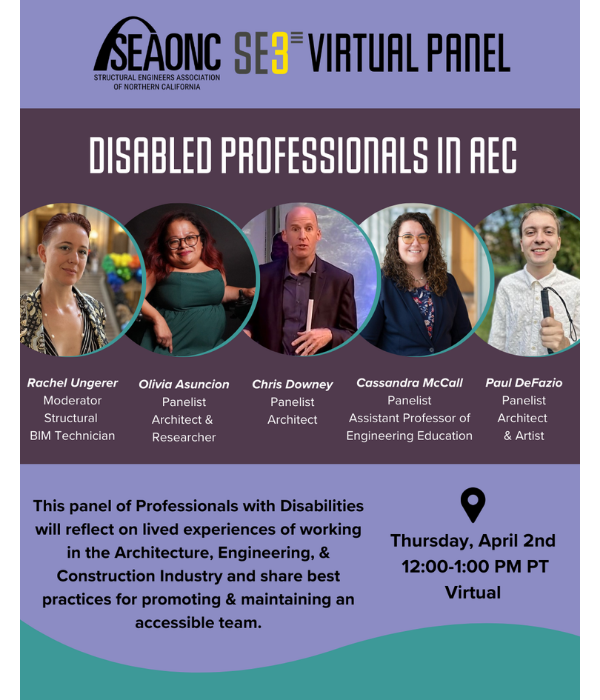
Image Description:
Text and Images on a purple background. Text reads: "SEAONC Structural Engineers Association of Northern California, SE3 Virtual Panel, Disabled Professionals in AEC." A headshot of each panelist & moderator with descriptions underneath: "Rachel Ungerer Moderator Structural BIM Technician, Olivia Asuncion Panelist Architect & Researcher, Chris Downey Panelist Architect, Cassandra McCall Panelist, Assistant Professor of Engineering Education, Paul DeFazio Panelist Architect & Artist." Text reads: "This panel of Professionals with Disabilities will reflect on lived experiences of working in the Architecture, Engineering, & Construction Industry and share best practices for promoting & maintaining an accessible team. Thursday, April 2nd, 12:00-1:00 PM PT Virtual"
This panel will explore lived experiences of professionals with disabilities working in the Architecture, Engineering, & Construction Industry. We hope to demystify what accessibility means in the workplace and promote teamwork between professionals with different access needs. SE3 is a subcommittee of SEAONC, Structural Engineers Association of Northern California, that is dedicated to using diversity, equity, and inclusion to attract and retain the best talents in structural engineering. Join us Thursday, April 2nd 12:00-1:00 PM PT for this Virtual Event!
Please note that the video link will send after you have registered.
Speakers
Rachel Ungerer (She/Her, They/Them)
Moderator
Structural BIM Specialist & Professional Artist
Rachel Ungerer | LinkedIn
Rachel is a professional drafter with over 8 years of experience working with structural engineers including Martin/Martin, Crosby Group, Tipping, and Rutherford+Chekene. Additionally, Rachel is a professional artist who uses art as activism to support the disabled queer community. Rachel has guest lectured on disability & ableism at Stanford and USC and is thrilled to bring her activism to her day job with this SE3 event.
Chris Downey, AIA, (He/Him)
Panelist
Architect
Chris Downey, AIA | LinkedIn
Chris Downey is an architect who designs buildings with acoustics and accessibility in mind. When Chris lost his vision suddenly 10 years ago due to a brain tumor, he stayed in his field and applied his new sense of space to his designs. Chris embraced tools such as a long cane and he networked with successful professionals who were also visually impaired. Chris began using tactile floor plans and has designed impressive, accessible buildings such as the San Francisco LightHouse for the Blind and Visually Impaired and the Duke Eye Center.
Cassandra McCall, PhD (She/Her)
Panelist
Assistant Professor of Engineering Education
Cassandra McCall | LinkedIn
Cassandra McCall is an Assistant Professor of Engineering Education at Utah State University whose research focuses on enhancing diversity and inclusion in engineering by challenging traditional conceptions of the field and examining how individuals develop their identities as engineers. She combines qualitative research with identity, culture, and critical frameworks to explore topics such as disability identity in engineering, hidden or non-apparent identities, de-stigmatization of disability, and the development of inclusive teaching practices using Universal Design for Learning. McCall holds a Ph.D. in Engineering Education from Virginia Tech, an M.S. in Civil Engineering, and a B.S. in Civil Engineering from the South Dakota School of Mines and Technology. Since joining USU in 2020, she has taught undergraduate engineering science and graduate engineering education courses, employing active learning approaches informed by research on identity, motivation, and conceptual understanding. Her work has been recognized with numerous awards, including USU’s 2024 College of Engineering Teacher of the Year and multiple mentoring honors.
Olivia Mae Asuncion, AIA (She/Her)
Panelist
Architect and Researcher
Olivia Mae Asuncion, AIA | LinkedIn
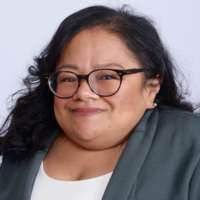
Olivia Mae M. Asuncion, AIA, is a licensed architect and design researcher from Oakland, California. She started her professional career helping Bay Area non-profit organizations with their construction, project, and property management needs, including the Ed Roberts Campus, a universally designed building in Berkeley that hosts several disability organizations. Her architecture experience includes the design and construction of public safety buildings, public sector office and community spaces, and K-12 educational facilities. Asuncion is also passionate about improving architecture through environmental design research. Notable projects include: a study assessing the efficacy and accessibility of existing evacuation protocols and building safety codes for people with disabilities; a collaboration with University of Oregon faculty on the post-occupancy evaluation of the Ed Roberts Campus; and a Fulbright Program project studying the accessibility of elementary schools in the Philippines. In addition, she has lectured on the importance of accessibility in the built environment to university students and design professionals. Asuncion is an active member of and has served as a Young Architect leader for the American Institute of Architects. She received her Bachelor of Arts degree in Architecture from the University of California at Berkeley and her Master of Architecture degree from the University of Oregon.
Paul DeFazio (He/Him)
Panelist
Architect
Paul DeFazio | Institute for Human Centered Design
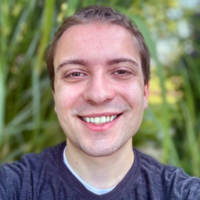
Paul DeFazio is an artist and architect whose work centers on the integration of disability and design practice. A 2024 Fellow at the Institute for Human Centered Design (IHCD), he contributed to design review tools for the Massachusetts Bay Transportation Authority, campus transition planning initiatives for Tufts University and Louisiana State University, and a design guide for the Massachusetts Department of Conservation and Recreation. He holds a Master of Architecture from Rice University and a Bachelor of Fine Arts from Edinboro University, and his research explores blind methodologies of design, the politics of access, and the advancement of disabled leadership within the design professions. Currently an Inclusive Architectural Designer at IHCD, he works on projects such as Building a World Fit for People, an interview series highlighting disabled designers, and is part of the team developing an inclusive design guide for Vassar College. Paul is also a core member of the Critical Design Lab, where he manages the Critical Access Primer and collaborates on initiatives including Labs for Liberation—a design summer school co-organized with Digital Apothecary—and Disability Meets Architecture, a dialogue series developed with the DisOrdinary Architecture Project. As a legally blind designer, he brings lived experience to disability advocacy, design education, and inclusive practice, and has served as a guest lecturer at Northeastern University and the Boston Architectural College. He is committed to design that blurs the boundaries between theory, practice, and advocacy, using disability as a radical lens through which to rethink architecture and the built environment.